How a Burmese Documentary Filmmaker was Forced into Hiding During Minnesota’s ICE Crackdown

Like what you read? Subscribe to Eco Files. And consider a paid subscription to help Alleen Brown keep doing independent journalism.
It was a friend who I’ve known since junior high, who told me that Thet Oo Maung and his family were in hiding in my childhood neighborhood. He and his wife, Thazin Thaung, run a little shop called Your Enchanted Florist in St. Paul, Minnesota. My friend's mom arranges flowers there. And one day, ICE agents in ski masks parked outside the shop and just sat there, waiting.
St. Paul’s Como neighborhood is made up of modest houses and quiet streets, centered around a big park. People walk their strollers around Como Lake. Kids play basketball at the rec center. Teens work at fast food restaurants and sneak onto the golf course at night to party. Maybe there’s an alcoholic neighbor who screams at his wife, and there has been a murder or two, but, for the most part, nothing much happens there. As of 2020, almost one in five people in St. Paul were foreign-born, but the proportion was only 7 percent in Como.
So I had one of those jolts — a stabby, tight-chested feeling that has happened more and more over the past six or dozen years or so — when I heard that Thet and Thazin had stopped going outside. They’d pulled their 9-year-old son out of school, and my friend’s sister was bringing them groceries from her job at a grocery store.
Since Trump sent masked men pouring into Minneapolis, I had been glued to social media from where I live in Brooklyn, watching the ICE agents harass and arrest people all over my city. I lived in Minneapolis — St. Paul’s twin city — for a chunk of my adulthood and still go back a lot. Disturbed as I was about what was happening there, my brain could somewhat process that ICE was terrorizing people in Minneapolis, the more cosmopolitan of the twins. But if ICE was in Como, then they were everywhere. It meant there was no safe place.
I felt another jolt when I learned that Thet had been forced to leave Myanmar because of his work as a documentary filmmaker and photographer. It’s not a huge leap to say that he was being terrorized in St. Paul as a result of doing the same type of work that I do now – telling stories that challenge powerful people. The Trump administration had managed to take up the repressive practices of the Burmese military government and stretch Thet’s punishment for doing journalism into a place that he thought would be a refuge – somewhere as dull as Como Park.
I’d been feeling pretty useless, hundreds of miles away from the mutual aid efforts and disaster planning that had consumed so many Minnesota friends’ lives. So I reached out to Thet as much as a comfort for myself — something to do with my hands — as anything altruistic. It’s been hard in recent years to feel like journalism changes much, but it’s something I know how to do. I figured, since Thet was a storyteller, too, he might be waiting for an invitation to tell his.
A Filmmaker Working Against the Censor
“You have to leave now,” Thet’s friend told him over the phone, five years ago in Myanmar’s biggest city, Yangon.
“I didn’t believe it,” Thet remembered. But his life was about to change forever.
In Yangon, Thet used to hang around with a lot of artists — they would paint, and he would take photos. But it was the Saffron Revolution of 2007 that hooked him on street photography. The revolution was named for the red robes of the Buddhist monks who led waves of civil disobedience — it was a visual story.
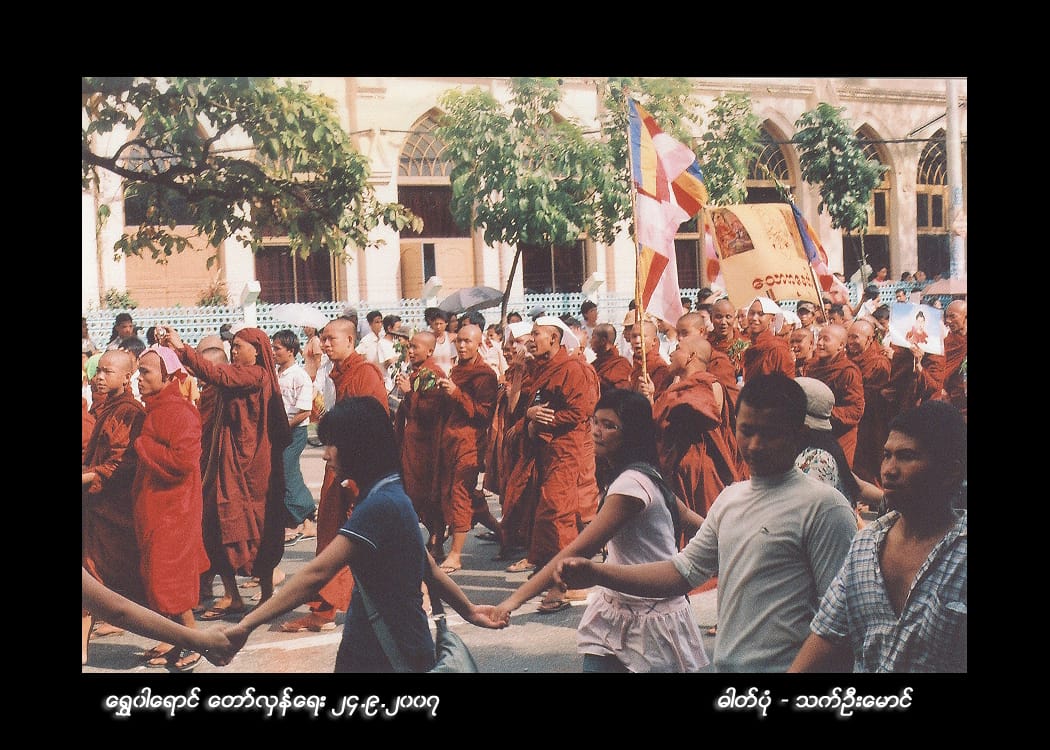
A few years later, Thet turned to filmmaking, after taking courses at Yangon film school, which was started by a German filmmaker whose mother had Burmese heritage. He made quiet character studies. One short focused on a Karen neighbor who had lost his legs to a landmine planted as part of the long-running civil war between Myanmar’s government and Karen dissidents. In another, Thet visited a lonely aging photographer, who flipped through an album of black and white portraits he’d made of families long gone.
The Old Photographer. Film by Thet Ooo Maung
Dealing with censorship and state repression became part of the work. Although this was considered Myanmar’s democratic period, military leaders still had a grip on the country, and even the Nobel Peace Prize winning leader Aung San Suu Kyi defended the Burmese military as they committed genocide against Muslim Rohingya people.
Thet has brown skin and used to wear a beard. When he visited the Rohingya part of the country, he had to bribe local officials to leave him alone. At a restaurant where he and his colleagues ate, he ordered pork to convince them he wasn’t Muslim. When police approached them as they filmed at a massacre site, they lied and said they were working on a fun music video. To avoid censorship, Thet submitted his films to international film festivals instead of local ones.
But as time went on he became more bold. The Movies that Matter film festival in the Hague, Netherlands, offered a training on how to organize a human rights film festival, and in 2019 Thet started a film festival in Yangon. To skirt the censors, it was held in a German international center and was officially a private event, but over 3,000 people showed up. The plainclothes secret police who attended were obvious — for one, they reeked of alcohol — and occasionally snapped photos of Thet and attendees. The next year, with people stuck at home because of Covid, over 30,000 people joined remotely.

The work was going well, but the issues with the government were about to get a lot worse. In 2021, the military staged a coup, imprisoning the country’s elected leaders, including Suu Kyi. It sparked a huge popular uprising. Tens of thousands of people poured into the streets, and Thet began filming again. In one his films, people conduct a sit-in in front of a building and hold three fingers in the air, the movement’s symbol of defiance. He interviewed an artist, who had designed a poster depicting two automatic rifles criss-crossed across a pair of lips, that stated “Stop Killing us.” By then police were firing live rounds into the crowds of protesters.
Thet’s friends began disappearing as night raids swept the city. And before long, he got that fateful call.
The Crackdown
The friend who called had been a political prisoner and had a source inside the police force. Thet was going to be arrested, the friend said, and he needed to escape now. It didn’t make sense to Thet, and he tried to shake it off. He was not a famous person, and he couldn’t see why would government officials would bother with him.
Then he learned that police carrying automatic rifles had parked in front of his mother’s house, waiting. It was time to go.
Thazin and their four-year-old son went to her sister’s house, and Thet left Yangon entirely. He crossed into a region of the country controlled by Karen dissidents who had been fighting for autonomy since the 1940s. For two months he hid there, alongside other activists. They would bathe in the river and sometimes slept in a cave to avoid government bombing campaigns.
“When will you come back?” his 4-year-old son asked in video calls. It got to be too hard to be apart, and Thet arranged for the family to reunite in a safe house back in Yangon. Another two months went by. With martial law in place, a curfew had been set for 9 pm. It meant that the trucks driving by at night were military or police. They couldn’t turn the lights on at night for fear someone might knock. Outside, explosions and gunshots went off. Thet didn’t sleep much.
When he learned the government planned to begin going door to door, looking for dissidents, it was time to go again.
He returned to the Karen region, this time with his family. It was hard on their son. The night they arrived in the village, a neighbor accidentally set off a stash of explosive devices, destroying a hut and killing multiple people. His son was terrified, and, more seriously, the smoke was likely to draw the military to their location.
The Karen-controlled area is on the border with Thailand. Thet hired human traffickers to smuggle them across the small stream dividing Myanmar from Thailand. Thai border guards intercepted them, aiming their automatic weapons toward Thet and his son. The traffickers spoke to them, and the border guards let them continue. They were safe.
Back in Myanmar, by the end of the year, security forces had killed nearly 1,500 people, including at least 100 children, and detained more than 11,000 politicians, activists, journalists, and others.
Thet and Thazin followed all the rules, from there. They reached out to the International Organization for Migration, and after several months, the family learned they had been granted asylum in the United States. The immigration officials asked them where they wanted to go.
Thet called an activist friend who had recently resettled in Minnesota. “This is a nice place,” the friend told him.
Thet told the agency, “I will go to St. Paul.”
A Safe Place
The first thing he noticed was the snow. “I had never seen snow in my life,” he said. It was difficult, at first, to drive in it. But when he learned about the Walker Art Center and its sculpture of a cherry sitting on the lip of a giant spoon, he thought that there might be something in this place for him.
Thazin got a job at the Lyngblomsten nursing home, where some of my friends from high school once worked, and Thet started delivering pizzas for Domino’s, while doing Burmese interpretation on the side.
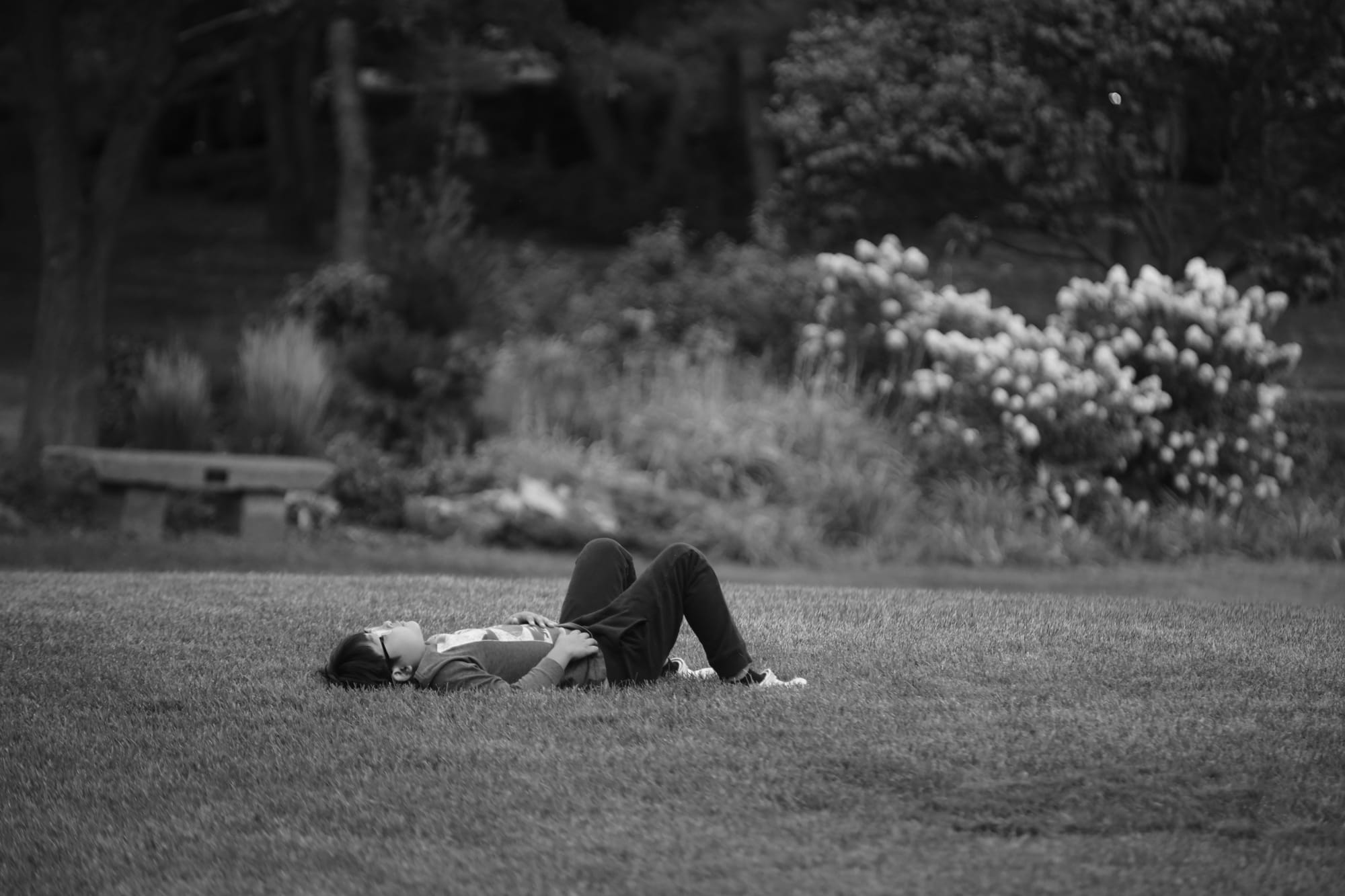
Their son started Kindergarten and was soon speaking English better than Burmese. He still struggled with the fourth of July, though, when fireworks would go off, booming like the explosions he heard in Myanmar while they were in hiding. But his anxiety and attachment to his parents had started to lift, and at nine years old, he’d become more independent.
The family was putting the terror they’d felt in Myanmar behind them. “I felt, oh, those times are over,” Thet said.
Good things kept coming. Thazin used to arrange flowers in Myanmar, so she started working part time at the flower shop. When the business went up for sale, they bought it. Meanwhile Thet joined a street photography group and a documentary filmmaker club. A gallery and café even exhibited his photography.
Thet Oo Maung made the film Beat Up, after immigrating to St. Paul.
When Thet heard about the ICE surge, he figured they were safe. He had all his documents, including a green card approval letter, although he didn’t have the card itself yet. As for a criminal record, he didn’t even have a speeding ticket. Why would they bother with him?
Then one day, he got another one of those unexpected phone calls. Someone he didn’t know called the flower shop and asked him for his cell phone number. He gave it to them.
Thet’s life was about to change.
Hiding — Again
The caller was with a group of observers, monitoring ICE activity in the area, and the text message contained a photo of a black Nissan. “This is an ICE car, going around the neighborhood,” the stranger told him. Thet tried not to worry.
The shop phone rang again. For the second time that day, the caller asked for Thet’s number. This time it was a neighbor. She could see from her upper-level apartment that the black Nissan was now parked next to the shop — and it was full of masked men.
A realization washed over Thet. “Are we the targets?” They were the only immigrant-owned business close-by, and their neighbors were mostly U.S.-born.
Several people showed up at the door, wearing yellow vests and whistles around their necks. They were ICE observers, they explained, adding, “You need to lock your door.”
They flipped the lock, and then Thet had a panic attack. Tears welled up, as his mind raced. “How can I leave my son alone?” he thought. They had payments due. “How are we going to leave the business?” He sat down to collect himself, and the ICE observers watched out the window, as they all waited. My friend’s dad — an Italian American Minnesotan who I always sort of thought of as a football dad, the kind of guy who was always watching the game, not super political — had arrived, and he stood outside the door, with his arms folded.
Through the feeds of the store’s security cameras, Thet could see the masked men in their car. An hour went by. Then, they drove away.
Thet and Thazin finished their orders for the day, then closed early. They lived above the business, and to get from the store to their apartment, they had to walk outside, take a few steps then go upstairs. My friend’s mom slipped outside to unlock their apartment door. Then the ICE observers surrounded Thet and Thazin like it was a military operation and escorted them the few steps from door to door. They rushed upstairs to safety.
It was the beginning of a new routine. The business door stayed locked, opened only for customers and employees. Thet and Thazin developed their own system for getting between home and the shop. “Like a spying game,” Thet explained. They’d get on their phones, and one of them would watch out the upstairs window to make sure no one was waiting. “Every day is like this,” Thet said.
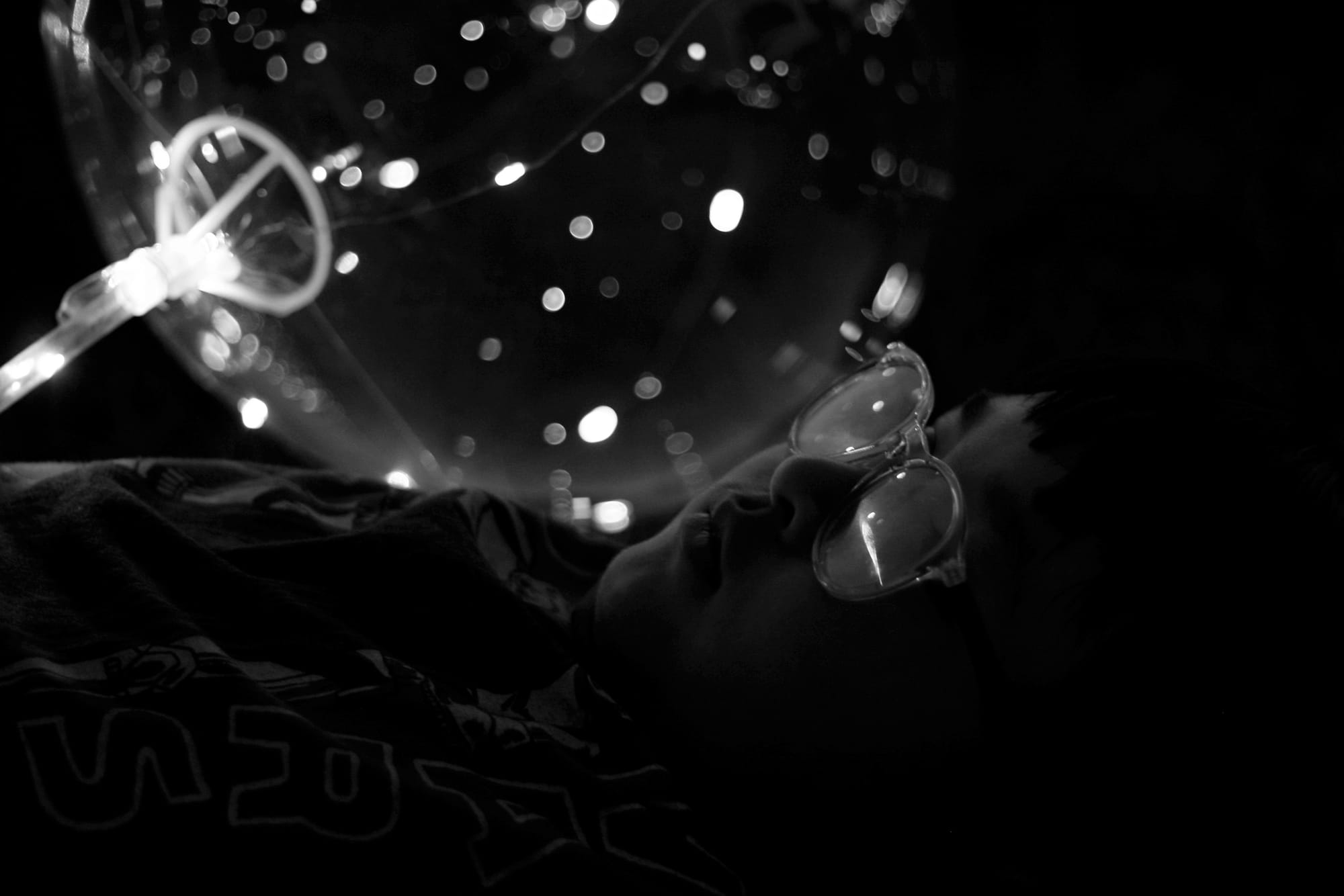
They couldn’t fathom the idea of their son coming home to find them gone, so they enrolled him in online learning, and he stayed upstairs. Weeks went by.
They weren’t alone. Across the Twin Cities, thousands of immigrants were staying home. While they hid, ICE arrested over 3,700 immigrants in Minnesota. More than 100 of them were refugees like Thet who had followed a rigorous process to obtain permission to come to the United States to live. They were tackled onto the pavement, or yanked from their vehicle, or beaten before being flown shackled to a prison in Texas. If they were released, they had to find their own way home.
Refugees and asylum seekers from Myanmar, who had undergone experiences similar to Thet’s and followed all the rules, were among those arrested. Te Eh Doh Lah, for example showed ICE her papers when they showed up at her home in St. Paul. They shackled her anyway, sending her thousands of miles away from her three kids, including an infant she was still breastfeeding.
Thet and Thazin tried to make jokes about it. “It’s not our first time hiding in the house,” they’d say. Except unlike in Myanmar, there was nowhere in the U.S. they could disappear to. For one thing, there were cameras everywhere — they’d be traced wherever they went. Also, rules around asylum meant that Thet couldn’t simply go to Canada and seek refuge there.
The comparisons people were making between ICE and the Nazi Gestapo resonated. As he saw it, there was no need for the U.S. government to build a gas chamber for refugees like him. “ If they send me back to my country that's a gas chamber for me," he said. "I'm going to die or be tortured or maybe, you know, a life sentence.” In August, Myanmar had declared the Karen National Union a terrorist organization. Since Thet had gone into hiding in the Karen autonomous area, he figured he could be charged with a terrorism-related crime, in addition to crimes related to his films. He knew of plenty of political prisoners who died by torture during interrogations, and others who left prison permanently disabled. Women and children could be imprisoned, too.
Whenever someone parked outside the business, the family was gripped with fear. “Is it ICE? Who are they? What will we do if they come to the door? Are they waiting for us?”
They watched online as things escalated, and the violence soon extended to citizens who were protesting or trying to block ICE arrests. An ICE agent shot and killed Renée Good, then Alex Pretti. “They even shoot their own U.S. citizens,” Thet thought. “So they could do anything to immigrants.”
But something else was happening, too.
A Trip to the Art Museum
Every day, Thet received a text message from the ICE observers. “Hey, are you okay? Do you need anything?”
Volunteers started doing the flower deliveries for the shop, since Thet couldn’t drive anymore. For the most part, my friend’s sister brought groceries from her grocery store job, but one day a random bag of groceries appeared outside their door from someone they didn’t know. Another time, a neighbor dropped off a $200 donation in an envelope.
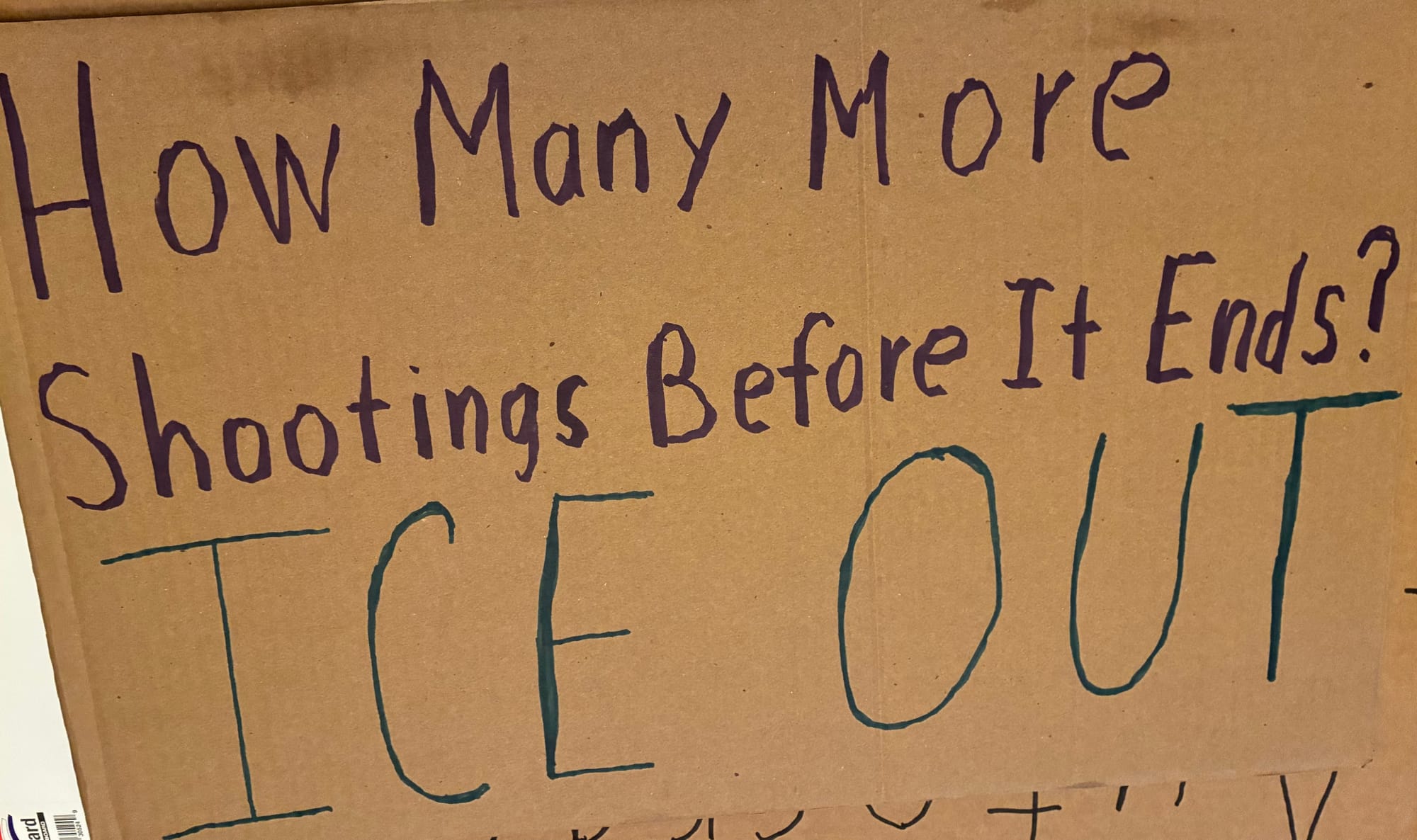
My friend’s football dad, stood on the busy corner of Larpenteur and Lexington nearby every weekend, holding cardboard signs that said things like, “How many more shootings before it ends? ICE OUT.” It was personal for him. When he was little, he and his family had immigrated from southern Italy, to escape poverty left in the wake of Benito Mussolini's fascist policies. He didn't want to see the U.S. face a similar fate under Trump.
A whole community of people had suddenly emerged to support Thet and Thazin and their son.
Then, on January 23, something like 50,000 people poured into the Minneapolis streets on a day where the temperature dipped to 20 degrees below zero, for a general strike in protest of ICE. Thet was stunned. “They're not even fighting for themselves — they're fighting for immigrants. They can stay and enjoy their home, in the cold winter,” he remarked. It meant a lot to him. “In my experiences, we were fighting for ourselves, like for our own rights, but what they're doing is not only for them — they’re fighting for someone else.”
Still, it was becoming immensely tedious to be stuck inside. He sent the ICE observers a note. “ Hey, this might be weird. If you say no, I'm okay, but I feel like I want to go walk around in the Walker Art Center again,” he wrote. The person on the other line agreed to help. And on a Tuesday — free admission night — a family picked them up and drove them across town to the art museum. For a few hours they were free.
Meandering the halls of the museum, he paused for awhile at a video installation by the artist Mircea Cantor, called Deeparture. In it, a deer and a wolf tensely occupy a sparse, white gallery together, for three hours. “Am I the deer or the wolf?” he thought. Thet had been the wolf before, but right now, he figured he must be the deer. In the film, despite the close proximity of the predator to its prey, the tension never breaks — the wolf never attacks.
The ICE observers continued to give the family updates on ICE’s movements in the neighborhood, and ICE did come back and park in front of the shop another weekend. The observers stood watch, and the agents eventually drove away.
When Thet and I first spoke, border czar Tom Homan had just announced the conclusion of Operation Metro Surge. He and Thazin had begun to run small errands again, like going to the flower wholesaler in the morning, where Thazin could choose the best buds. They’d head out at 6:30 in the morning, in hopes of beating any lingering ICE agents. The daily ritual used to feel like a chore to Thet, but now it was a luxury.
But they were still being cautious. On Valentine’s Day, the shop's busiest day of the year, three or four families from the neighborhood showed up to help them with the deliveries. They wouldn’t even accept gift cards as thanks.
Throughout all this, Thet hadn’t reached for his camera. “ I used to make stories out of other people, then I became a story,” he said. “I’m exhausted.”
Even as some of the ICE agents began leaving the state, a sense lingered with Thet that the United States of America was more like Myanmar, one of the most notorious countries in the world for human rights abuses, than he and Thazin had bargained for. The ICE arrests and shootings, the Trump administration’s ballooning claims of domestic terrorism and the president’s Islamophobic tirades against U.S. Rep Ilhan Omar of Minneapolis all reminded Thet of what he’d fled. “I've seen it in my country. This is how it happens. You start talking trash and dehumanizing groups of people and then it becomes a massacre, impunity, followed by genocides — and still impunity,” Thet said. “I’m afraid to see that again.”

I’d planned to write this story using pseudonyms and cryptic references to the flower shop's location. But when I checked back in with Thet last week, I learned that the family’s situation had shifted significantly. On the day before Easter Sunday, they received their green cards. "We feel safe," Thet told me. "We don't need to watch our back anymore." They celebrated the holiday hopeful that the feeling would last this time.
To follow Alleen Brown's independent journalism, subscribe! And to keep Eco Files alive, select a paid subscription.
Member discussion