Eco Roundup: Body Cam Footage Exposes the Narrative War Behind An Indigenous Activist’s Arrest
Today we have another experiment in collaboration! A version of this post is also being published in Drilled's newsletter. Drilled puts out excellent investigative environmental journalism on its podcast and in print — it's where I publish a lot of my work. Subscribe to the Drilled newsletter to keep track of it all. And if you want to help us keep this kind of journalism going, take advantage of discounts we're offering for subscriptions to Eco Files and Drilled.
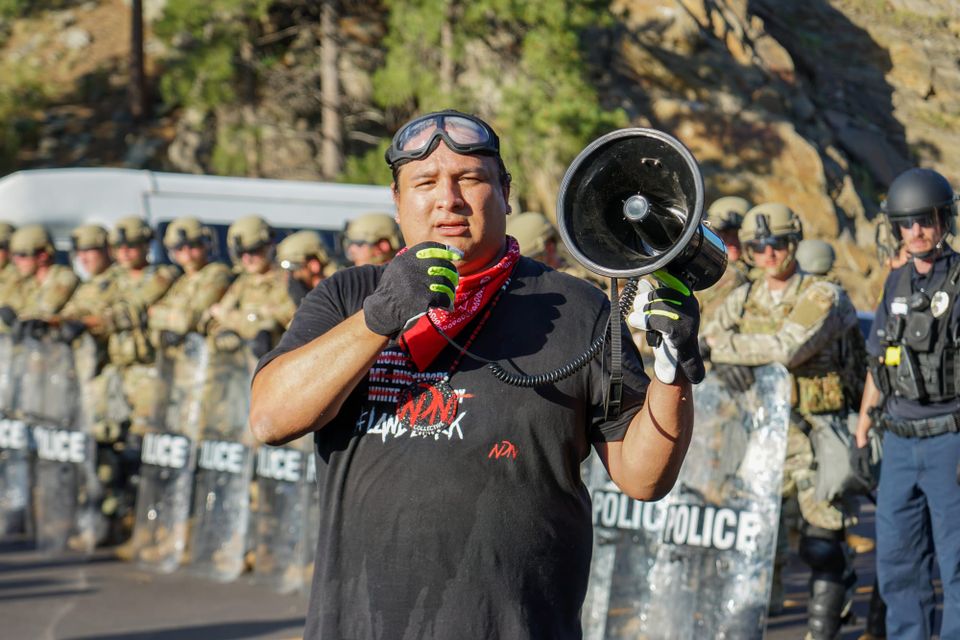
I’ve been thinking a lot about something the Oglala Lakota activist Nick Tilsen said to me in an interview for the story about him we’re publishing today on Drilled’s web site. We met in the office of the organization he founded, NDN Collective, in Rapid City, South Dakota last March. I was about to go pick up a flash drive from the Pennington County Court, containing body camera and surveillance video footage of the night a cop accused Tilsen of attempting to run him over.
He told me, “ I think that what people don't realize is when prosecutors and police bring politically motivated charges like this, it's often a narrative war.” I’ve been covering the criminalization of land and environmental defenders for a decade now, and that resonated.
You should go to Drilled’s web site, and read the story, but to summarize, in June 2022 Tilsen was attempting to observe as the officer questioned an Indigenous community member. Rapid City police have a reputation for discriminating against Indigenous residents, and Tilsen wanted to make sure the man wasn’t abused. He pulled into a parking spot where the cop was standing, and the officer accused Tilsen of trying to hit him. However, no charges were filed until a year later, four days before a protest that NDN Collective was planning, against racist policing. One day, the mayor gave a press conference calling the protest a public safety threat, and literally the next day Tilsen was accused of two felonies for the incident a year earlier. The case was finally dismissed this past March, after a trial ended with a hung jury.
I had asked Tilsen why he thought police, prosecutors, and the court had been so hesitant to provide me with the video footage of the incident, and he replied that this was a battle over story. “ They want to use taxpayers’ dollars to try to make it look like they're being hard on these criminals, to discredit what we are and what we're about and what we're fighting for in the world,” he said. (Of course, police and prosecutors told me that none of this was based on protected speech or planned demonstrations. The prosecutor believed that the videos had potential to bias a potential jury pool.)
Body Cam footage from the day Nick Tilsen was accused of trying to run over a cop.
Surveillance video of the incident.
In Rapid City, the fight for the story of America is visible everywhere. Driving west, South Dakota’s undulating prairies erupt into a line of pine trees that mark the beginning of the Black Hills, an immensely important and sacred place for many Indigenous nations. Rapid City is nestled right in that transition area between prairie and hills, which makes sense – this was the gateway town to a mining boom. Thirst for minerals led the U.S. government to break treaties with Indigenous nations and snatch away the hills. Since then, the Black Hills have become the highest profile land-back struggle Indigenous nations continue to fight.
In fact, while I was in town, NDN Collective and numerous other Indigenous groups, nations and individuals were knee-deep in a fight to protect an important part of the hills called Pe’Sla from exploratory graphite drilling. It involved lawsuits, community organizing, and direct action protests with lock-downs to equipment. The Trump administration has fast-tracked two other mining projects in the Black Hills, in accordance with an executive order accelerating extraction of so-called critical minerals used for electric vehicles as well as military weaponry.
It’s in those sacred hills that the U.S. government placed its most gaudy monument, Mount Rushmore, featuring four presidents’ giant heads carved in the stone. The message isn’t subtle.
At the courthouse, a friendly clerk handed me an envelope with my name on it. I exited down a grand staircase, where I noticed two gigantic paintings. One was a woman with a blond braid and a long skirt driving a train of oxen and covered wagons. In another, three bearded men panned for gold in a stream. In this city’s hall of justice, where Indigenous people are disproportionately charged with crimes, the story of white settlement and mining dominate the space.
As I watched the body cam footage back in my hotel room, I couldn’t help but be distracted by a bronze statue of Bill Clinton in the background, grinning and holding a microphone. It’s one of 44 statues of presidents located all throughout the town, as if Mount Rushmore wasn’t enough.
Additional footage of the incident.
The story all these monuments tell is that Indigenous people lost — this place is the heart of America now, rather than the heart of any Indigenous nation’s world. It’s also a story that says land and ecosystems are resources that exist to be dominated and transformed into money, rather than places that have inherent purpose independent of financial reward.
Twice the last couple months, I’ve seen that story disrupted. Once, it was subtle. I was driving in Rapid City and glanced at one of those blinking digital billboards. “They got money for wars but can’t feed the poor.” I didn’t expect to see a Tupac Shakur quote in a part of the country saturated with anti-abortion billboards. NDN Collective had put it up.
The second time I saw the narrative interrupted, I was back home. A source in North Dakota, where Indigenous people and tribes had also been fighting to protect Pe’Sla texted me a letter written by the COO of Pete Lien & Sons, the company behind the graphite drilling. They were formally withdrawing their mining plans. “PLS stands ready and willing to perform all reclamation at the site,” it said.
It’s a good story — a disruptive story. As Tilsen put it, “Narratives that authentically come from the front lines of Indigenous people, Indigenous struggle, have the ability to create ripple effects of change and outlast the narratives that are being imposed against us.”
Correction: An earlier version of this story said the footage came from the Rapid City Police Department. It was actually from the Pennington County Court.
Other stories I’m following:
“Australian Oil and Gas Company Santos Offered Communities Help in Exchange for Good PR,” by Royce Kurmelovs for Drilled. For another great Drilled story about controlling the narrative, check out Royce’s investigation into how an Australian oil and gas company offered flood aid — with a catch. People in need of aid could fill out a form that asked applicants to “please detail how you will promote the Santos brand,” followed by a list of options. In other words a climate polluter seems to have been trying to squeeze good PR out of the people most harmed by climate impacts. While you’re on the site, check out Amy Westervelt’s new narrative podcast series, Carbon Cowboys, and, if you haven’t already, read Nina Lakhani’s report-back from the Santa Marta Climate Conference.
“How Trump’s New Counterterrorism Strategy Puts You at Risk,” by Nick Turse, Jessica Washington, and Noah Hurowitz at The Intercept. This month, the Trump administration released its 2026 Counterterrorism Strategy, called “America First Counterterrorism.” It names three groups of people that the White House considers the nation’s biggest threats: “Legacy Islamist Terrorists,” “Narcoterrorists and Transnational Gangs,” and “Violent Left-Wing Extremists, including Anarchists and Anti-Fascists.” They define that last group as including “anti-American, radically pro-transgender, and anarchist” ideologies. This is a policy that will inevitably target climate and environmental defenders. Reporters at The Intercept annotated the document to help you parse what it means.
“‘Keystone Light’: These Wyoming Oil Tycoons are Reviving the Controversial Pipeline,” by Jake Bittle & Naveena Sadasivam for Grist — Donald Trump has signed a presidential permit that could bring back to life a version of the Keystone XL Pipeline, and Grist has the best story I’ve read so far about it. The piece gets into the backstory of the Wyoming family behind what’s being called the Bridger expansion pipeline, including the various oil spills their other pipelines have produced. The project would carry tar sands oil from Canada toward refineries on the Gulf Coast. Former President Joe Biden axed the original Keystone XL Pipeline, after years of protests and lawsuits by environmental and Indigenous advocates.
“North Dakota Supreme Court Orders Judge to Halt Dutch Suit against Dakota Access Pipeline Developer,” by Mary Steurer for North Dakota Monitor — In case you missed it, the North Dakota Supreme Court ruled that district court judge James Gion should order Greenpeace International to drop its Dutch anti-SLAPP suit (that’s Strategic Lawsuit Against Public Participation) against Energy Transfer, the Dakota Access Pipeline’s parent company. You may remember, I hosted an entire podcast season for Drilled, called SLAPP’d, about Energy Transfer’s crushing lawsuit against three Greenpeace organizations. Greenpeace International was attempting to block enforcement of the multimillion dollar North Dakota jury verdict by getting a court in Amsterdam to agree that the suit was abusive. Now they’ll have to consider whether continuing to pursue it might jeopardize their attempts in the U.S. to overturn the jury decision.
Navigating a global crossroads: Human rights defenders and business in 2025, report by the Business and Human Rights Centre — Climate, land or environmental defenders made up three quarters of the 790 attacks against human rights defenders documented in 2025 by the Business and Human Rights Centre. Nearly a third were Indigenous. And over half of the attacks involved judicial harassment, such as criminalization and SLAPP suits. This report named names: The top five projects and companies associated with attacks were the East African Crude Oil Pipeline (EACOP) in Uganda and Tanzania, the Grasberg gold and copper mine in Indonesia, the Cobre copper mine in Panama, the agribusiness company Dinant in Honduras, and Leonardo, an aerospace, defense and security company in Italy. The organization said it was the worst year since 2020.
Palate Cleansers
I cover topics that are heavy and distressing to take in, so I'm ending these posts with things that make me feel grounded: food, nature, community.
Something Delicious: Tea from home
It's been an intense few weeks for me, and in times like these, we must lean on our tried and true. For me, it's tea. When I moved to New York I searched all over for a good place to buy loose leaf tea. I figured there was no way my hometown of St. Paul, Minnesota, could have a better tea shop than a city like this. I was wrong. Tea Source reigns supreme, and I still order all my loose leaf tea from there. The teas of my heart: Karigane (green, grassy, the one that makes me feel balanced), Grand Keemun (a bold, rich kick in the ass when I need to get shit done), and Green Mango (tropical tartness for tricking myself into imaging I'm on vacation when you I a deadline).
Garden Update: My oldest plant friends
I have fantasies about buying grow lights, and planting rare types of peppers from seed in February. Every year I imagine I will get it together to sow pea pods or little radishes while it's still chilly and enjoy an early harvest. Lately, though, I'm wondering if I need to adjust my strategy and expectations. I never get to any of that, and the truth is that the plants that I feel the most supported by are the ones that show up for me, even when I did nothing. This year it's the two raspberry bushes, the magical strawberry plant, the unnameable native plants we bought for too much money, the hearty thyme, and the chives that are already showing us little purple flowers. Thanks for having my back, friends.
Community Updates: Killers of Roe
Drilled, our co-publisher today, launched with a podcast series based on journalist Amy Westervelt's idea that the story of the climate crisis could be transformed into a true crime story. My other favorite Amy's new book, Killers of Roe, shares a similar concept. Amy Littlefield, The Nation magazine's abortion access correspondent, profiles the people who killed Roe v. Wade, and how and why they did it. I personally love a villain story, and can't wait to dive into this one.
Liked what you read? Consider a paid subscription for 50% off. Subscribing to Eco Files supports my work directly, while subscribing to Drilled supports the institution that publishes much of my work.
Member discussion